
Technical price discovery decouples specialty coffee from commodity volatility. We analyze the C-Market basis, quality differentials, and the FOT valuation matrix to ensure transparency. Data driven valuation is the technical standard for excellence.
The Mechanics of Price Discovery: C-Market Basis and Specialty Differentials
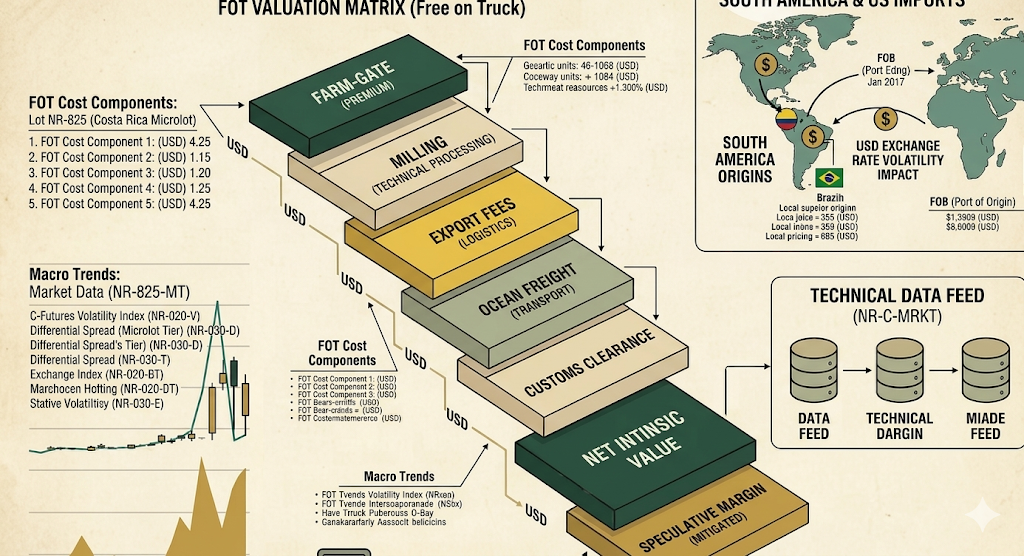
The global trade of coffee is a multi-layered economic system governed by standardized benchmarks and complex quality premiums. For the technical observer, understanding the price of a microlot requires looking beyond the retail sticker and into the mechanics of the Intercontinental Exchange (ICE) and the localized value chain. Price discovery is the process by which a specific lot moves from a commodity floor to a specialized valuation based on intrinsic quality and macro trends.
The C-Market as a Commodity Floor
The foundation of coffee pricing is the "C-Market," a global commodity futures exchange where Arabica coffee is traded. This market functions as a benchmark for the global supply and demand of "commodity grade" coffee. The prices quoted on the C-Market represent the cost of coffee that meets a basic industrial standard, often delivered to designated ports.
For the specialty coffee sector, the C-Market price serves as the "basis" or the absolute floor. It is a necessary reference point, but it rarely reflects the production costs or the technical value of high-scoring microlots. In this context, the price of a specialty coffee is mathematically expressed as the C-Market price plus a "differential."
The Anatomy of the Specialty Differential
The differential is the premium paid above the C-Market price to account for quality, scarcity, and origin-specific variables. This premium decouples specialty coffee from the volatility of the commodity market. Several factors determine the scale of this differential:
Sensory Scoring: Lots that achieve high cupping scores (typically 85 points and above on the SCA scale) command higher differentials.
Genetic Lineage: Rare varieties such as Gesha, SL28, or specific mutations often carry a higher basis due to lower yields and increased agronomic risk.
Traceability: The more granular the data regarding the farm, the washing station, and the specific drying lot, the higher the perceived value of the physical product.
The differential ensures that producers are compensated for the additional labor and technical oversight required to produce specialty grade coffee, which often involves hand-sorting, precise fermentation controls, and climate-controlled storage.
Value Chain Transparency: Free on Truck (FOT)
To understand the actual cost of coffee upon arrival, technical operators utilize the "Free on Truck" (FOT) valuation matrix. This figure represents the total cost of the coffee once it has cleared customs and is ready for domestic transport to a roasting facility. The FOT price is a sum of several distinct cost components within the value chain.
The process begins with the "Farm-Gate" price, which is the direct payment received by the producer. From there, costs accumulate as the coffee moves through milling (the removal of the parchment layer), technical processing, and bagging. Export fees, logistics, and ocean freight further increase the cost basis. Finally, customs clearance and duties are applied.
Analyzing the FOT price allows for a clear view of the "Net Intrinsic Value" of the coffee. It reveals how much of the final price is allocated to the quality of the product versus the logistical friction of moving heavy cargo across international borders.
The USD Denominator and Currency Volatility
A critical but often overlooked variable in coffee economics is the role of the United States Dollar (USD). Because coffee is a globally traded commodity, it is priced and settled almost exclusively in USD. This creates a significant macro-economic exposure for producers in countries like Brazil (BRL) or Colombia (COP).
When the USD strengthens against a producer's local currency, the "local price" for coffee may rise even if the global C-Market price remains stagnant. This can provide a temporary boost to producer revenue, yet it also increases the cost of imported inputs such as fertilizers and mechanical equipment. Conversely, a weak USD can squeeze producer margins even when global demand is high. Technical analysis of these currency fluctuations is essential for understanding the long-term stability and health of supply chain partners.
Data-Driven Stability
Price discovery in the specialty coffee world is an exercise in data management. By separating the commodity basis from the quality differential and accounting for the logistical layers of FOT valuation, roasters and importers can establish a fair and transparent market. This technical approach to pricing removes the speculative "noise" of the commodity exchange and refocuses the economic value on the biological and chemical excellence of the bean. Consistent, data-driven valuation is the only mechanism that ensures the continued viability of high-altitude, technical coffee production in an increasingly volatile global market.