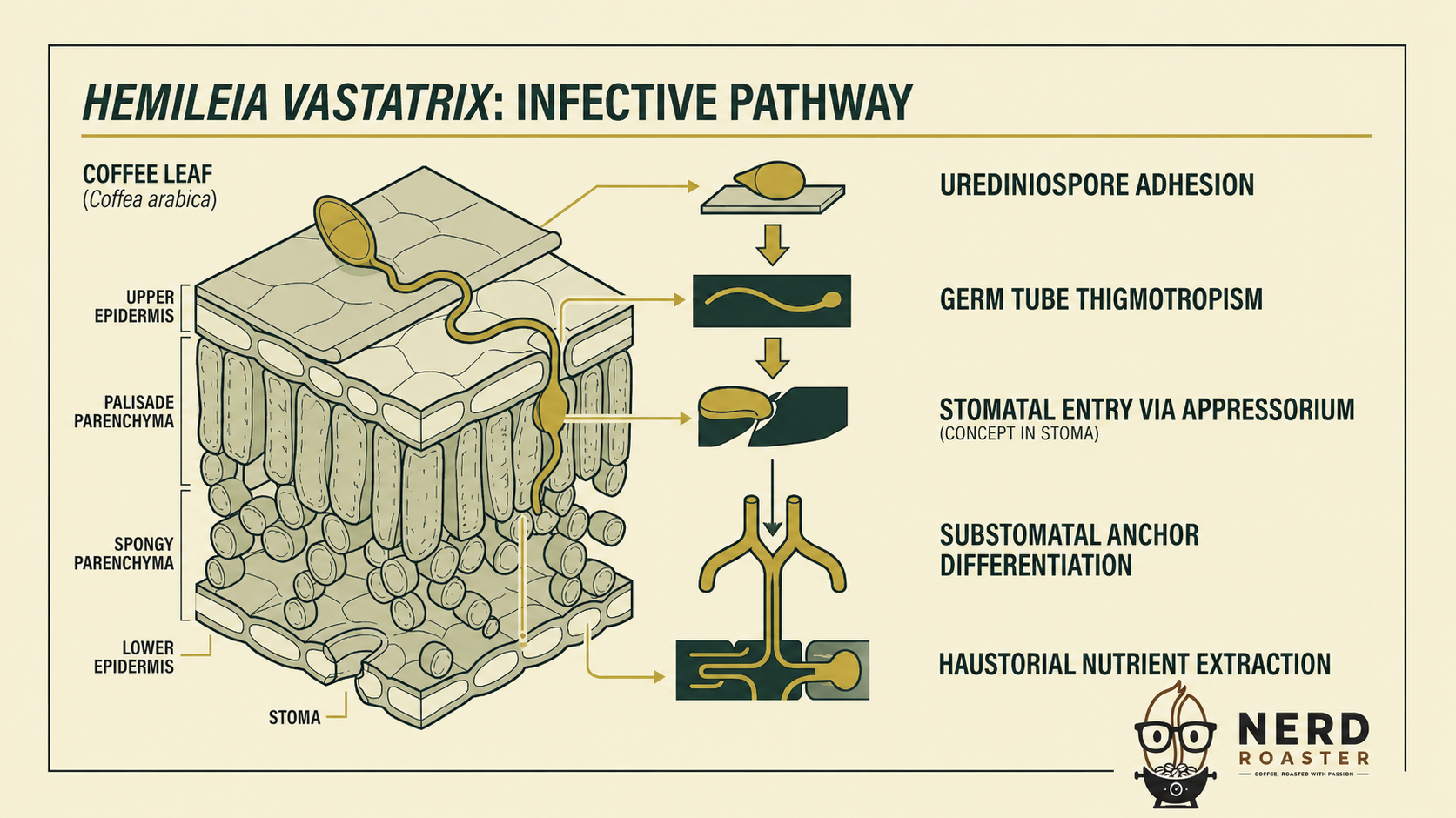
Understanding specialty resilience requires looking at cellular pathology. Hemileia vastatrix (Rust) bypasses host defenses via specialized substomatal anchors and haustoria, siphoning off the carbohydrates needed for bean density and sucrose development.
Coffee Leaf Rust: Cellular Pathology of Hemileia vastatrix
To evaluate specialty coffee resilience with professional agronomic rigor, a roaster must analyze the biotrophic mechanisms of Hemileia vastatrix, the obligate plant pathogen responsible for coffee leaf rust (CLR). Unlike standard necrotrophic fungi that destroy host tissue outright, H. vastatrix requires a living cellular matrix to survive, execute its replication cycle, and proliferate through geographic coffee zones.
The Infection and Colonization Sequence
The propagation of CLR operates on a strict sequence governed by microclimate thermodynamics and leaf topology:
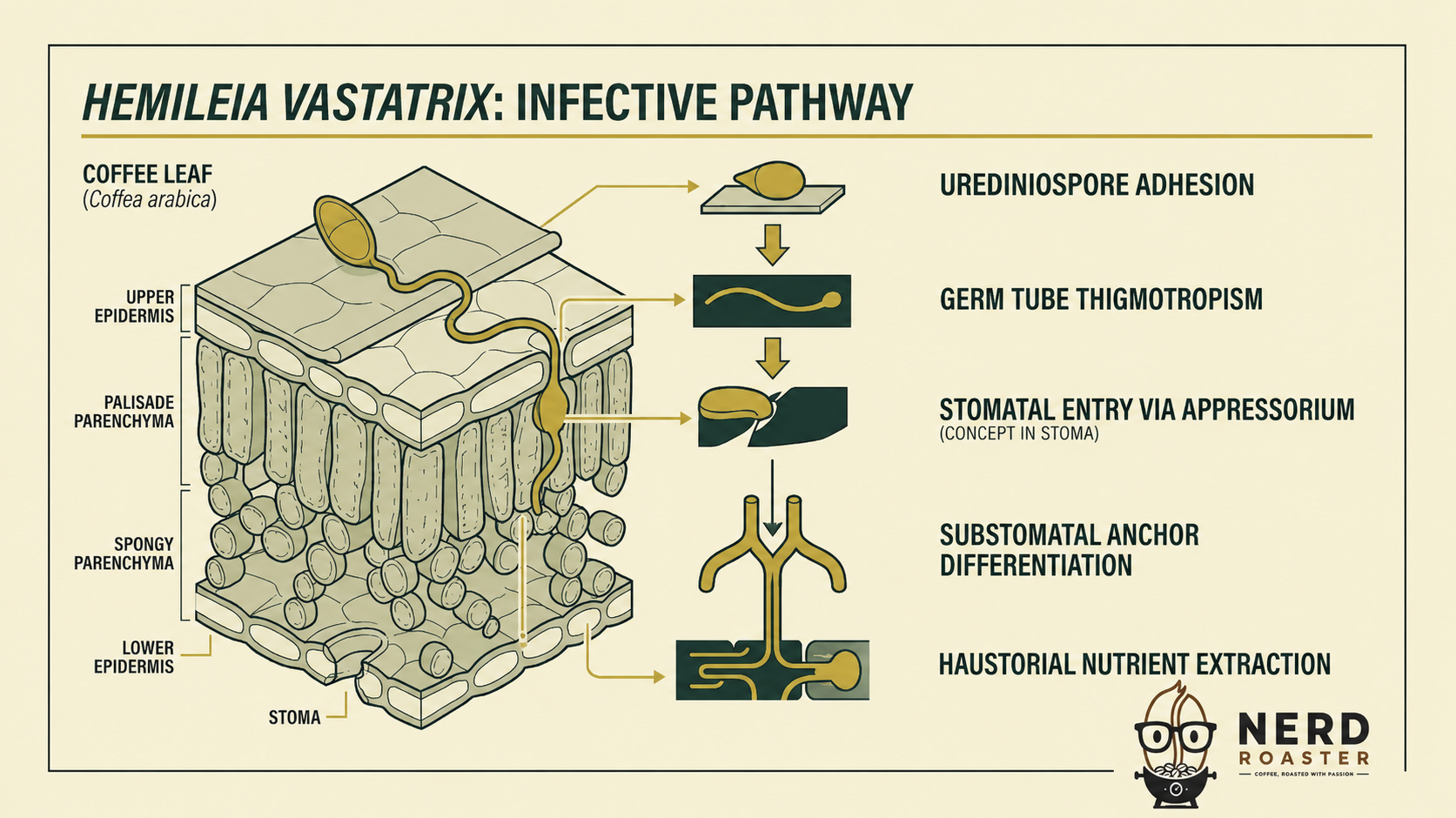
Adhesion and Sensation: Asexual, dikaryotic urediniospores land on the abaxial (underside) surface of the coffee leaf. The spore releases specific esterases to secure itself to the cuticular wax layer.
Thigmotropic Germination: Driven by physical surface cues and the absolute presence of liquid water, the spore germinates. The germ tube navigates the leaf topology to locate a stomatal opening.
The Substomatal Anchor: Once aligned over the stoma, the fungus differentiates an appressorium and pushes a penetration hypha into the substomatal chamber. Inside, it develops a specialized, thick, dual-branched structural "anchor."
Haustorial Extraction: From this anchor, the pathogen extends haustoria directly into the stomatal subsidiary and parenchyma cells. These structures penetrate the cell wall but remain external to the host's plasma membrane, systematically siphoning off hexose sugars and metabolic resources without immediately triggering host cell death.
Metabolic Defoliation and Quality Suppression
The primary macroscopic symptom of CLR is the emergence of orange, powdery pustules (suprastomatal sori) erupting back out through the stomata approximately three weeks post-penetration.
The physiological cost to the Coffea arabica plant is severe structural defoliation. As the fungal mycelium colonizes the spongy and palisade parenchyma, it destroys chlorophyll cells and severely limits the tree's net photosynthetic capacity. Because the plant must reallocate its remaining carbohydrate reserves to sustain basic metabolic survival, the source-to-sink relationship between the leaves and the fruiting cherries collapses.
For the specialty roaster, this metabolic starvation prevents the proper accumulation of essential compounds within the bean. Starved cherries cannot properly synthesize lipids, chlorogenic acids, or sucrose within the cellular matrix. The resulting green coffee lacks structural density, exhibits a hollow physical profile, and fails to develop the complex organic acids and volatile aromatics required during the pyrolytic stages of the roast.
Taste the Microlot
Reading about great coffee is one thing. Brewing it is another. Subscribe and get freshly roasted microlots delivered to your door every month.
Freshly roasted
Delivered monthly
Related Reading
Coffee Price Arbitrage, Yield Projections, and the Retail-Commodity Spread
The C-market correction is a structural supply shift. With forward projections placing the 2026/27 Brazil harvest at a potential record 75.9M bags, financial indices are pricing in a 10M bag global surplus, even as retail lag remains high.
In the specialty domain, evaluating macro pricing data requires analytical objectivity. To view coffee valuation through a sophisticated lens, akin to how an allocation strategist or a fine wine cella...
Fluid Dynamics of the Roasting Drum
Look past the bean temperature curve. Optimizing drum fluid dynamics means manipulating the Nusselt number to disrupt the stagnant boundary layer, ensuring uniform core development
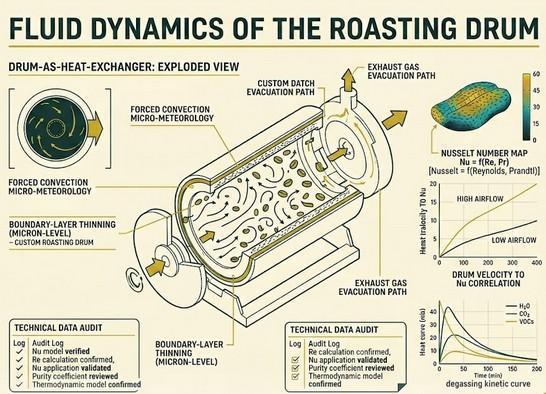
A deep technical understanding of coffee roasting requires looking past simple temperature curves and analyzing the fluid dynamics within the drum environment. The drum functions essentially as a spec...
A Technical Taxonomy of Species: Arabica vs Robusta
Arabica and Robusta aren't just different flavors; they are different machines. With double the chromosomes and 60% more lipids, Arabica is built for complexity. Robusta is a survivor, loaded with caffeine and CGA for chemical defense.
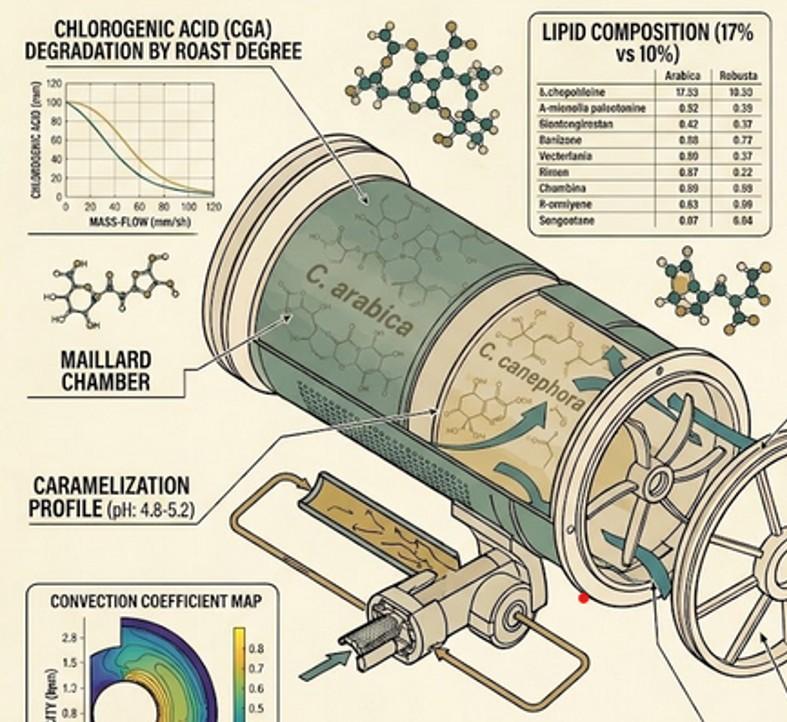
In the specialty sector, we often treat Arabica as the default, but a sophisticated understanding of roasting requires a deep dive into the divergent physical and chemical properties of C. arabica (...